
The question is whether the clocks allow enough time for two deeply mistrustful sides to get there, and whether the surface calm holds long enough for the paddling to produce something before the ceasefire ends on April 22, notes Prem Panicker in his must read blog on the Iran War.

Jet fuel prices on Wednesday were hiked by over 18 per cent -- the steepest ever increase -- to all-time high levels after international oil price surged to a multi-year high.

State-owned oil firms on Tuesday cut jet fuel, or ATF, prices by 4 per cent, the first reduction in rates since July, on softening of international oil prices.

The price of aviation turbine fuel, or jet fuel, in Delhi was hiked by Rs 1,039.1 per kilolitre, or 1.7 per cent, to Rs 62,208.18, according to Indian Oil Corp, the nation's largest oil firm.

Hike comes on back of a massive 6.14 per cent increase in rates effective from March 16 in line with rising crude oil prices.

Jet fuel (ATF) prices have been hiked by a steep 6.9 per cent, taking the rates to lifetime high of Rs 75,031 per kilolitre.

Jet fuel prices on Monday were hiked by a steep 5.3 per cent - the tenth straight increase this year -- to an all-time high, in line with a surge in global energy prices. The price of aviation turbine fuel (ATF) -- the fuel that helps aeroplanes fly -- was hiked by Rs 6,188.25 per kilolitre, or 5.29 per cent, to Rs 1,23,039.71 per kl (Rs 123 per litre) in the national capital, according to a price notification of state-owned fuel retailers. This is the 10th straight increase in jet fuel prices this year.
The International Energy Agency (IEA) has proposed immediate demand-side measures, including remote work, lower speed limits, and reduced air travel, to mitigate the impact of a global oil supply shock caused by Middle East disruptions.
While jet fuel price was increased by Rs 2, subsidised LPG price has been hiked by Rs 4.50 per 14.2-kg cylinder. Non-subsidised LPG to cost Rs 93 more.
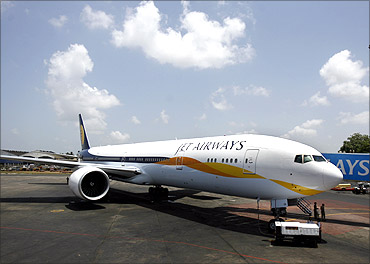
ATF price in Delhi was reduced by Rs 4,765.5 per kilolitre (kl), or 11.9 per cent.

This is the second straight increase in ATF price this month. Rates were hiked by a record 56.5 per cent (Rs 12,126.75 per kl) on June 1. Simultaneously, petrol and diesel prices were hiked for the 10th day in a row.

In a bid to bring down the cost of air operations, Aviation and Petroleum ministries will meet FM to get ATF notified as 'declared good'.

India emerged reasonably well from 2025. But now, the oil shock and war-related supply disruptions have again driven funds out of India and significantly weakened the rupee, points out Ajay Chhibber.

'Markets never fully lose hope. But an important shift could come if the Strait remains closed -- moving from high prices to no prices.'

India has rejected a request from BP Plc to be allowed to sell jet fuel to the booming aviation market.

A lesson for India is to clearly define objectives beforehand, so that the adversary or other parties do not attempt to mitigate them midway.

The state-run oil firms will raise jet fuel price by Rs 1,338 per kl effective midnight tonight, an Indian Oil official said on Thursday.

The state-owned oil firms on Wednesday hiked jet fuel prices by a huge 3.6 per cent to Rs 46,876.58 per kl, making it the fifth straight increase in rates since October when international crude oil prices started rising.
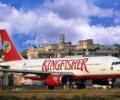
Mallya's airline is the second domestic carrier to have received DGFT approval for ATF import after budget carrier SpiceJet.

FIA is a body of four established domestic private airlines -- Jet Airways, IndiGo, SpiceJet and GoAir.
Jet fuel constitutes over 40 per cent of an airline's operating costs and the price cut will bring relief to the cash-strapped carriers.

The increases have snapped a six fortnight trend of reduction in rates.
State oil companies have raised aviation turbine fuel (or jet fuel) prices by 2.86 per cent in line with rising international oil prices.

Cooking oil is often discarded after being used for frying at home or in restaurants. However, a refinery of IndianOil has now won a certification to use the same oil to produce sustainable aviation fuel (SAF), the company chairman Arvinder Singh Sahney said.
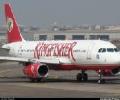
Seeking permission for direct import of jet fuel, Kingfisher Airlines has informed the government that steps are being taken to improve cash flow of the debt-ridden carrier by procuring ATF through suppliers' credit on lower interest rates.

Aviation turbine fuel or jet fuel price was on Wednesday hiked by a steep 9.2 per cent, while that of non-subsidised cooking gas was raised by Rs 21 per cylinder.
The change in the Foreign Trade Policy means that jet fuel sold in India to international flights will be treated as physical exports and not attract most of the domestic tariffs.
Jet fuel prices on Monday were hiked by a steep 6.5 per cent on the back of a rally in international oil prices. Aviation turbine fuel or ATF price was hiked by Rs 3,663 per kilolitre, or 6.5 per cent, to Rs 59,400.91 per kl in the national capital, according to a price notification of state-owned fuel retailers. This is the third increase in jet fuel prices since February. Rates were increased by 3.6 per cent on February 16, and by Rs 3,246.75 per kl on February 1. The increase in rates will add to the margin woes of airlines who continue to operate flights at less than capacity, amid pandemic-driven travel restrictions.
Aviation Turbine Fuel or jet fuel in Delhi, the city that houses the nation's second busiest airport, costs $1,291 per kilolitre while the same in Singapore is sold at $1,067 per kl. It costs $1,100 per kl in Hong Kong and $1,113 in Colombo.
A senior civil aviation ministry official said this was one of the key issues discussed during Civil Aviation Minister Praful Patel's meeting with Prime Minister Manmohan Singh on Wednesday to ask for a relief on ATF. Top airline executives like Jet Airways Chairman Naresh Goyal and Kingfisher Airlines Chairman Vijay Mallya also met the PM to highlight the issue.

India's aviation sector is facing fresh turbulence, with rising fuel costs, the Ministry of Civil Aviation's free-seat directive, and geopolitical disruptions in West Asia clouding near-term earnings visibility.
Aviation industry sources said some of the airlines were also planning to consolidate their flight schedules, by cutting some flights to certain select destinations. Indian carriers were also focusing on getting their products to a global standard and consolidating their domestic market, the study also pointed out.
Lower crude oil prices are expected to bring down jet fuel rates by 10 per cent in September, but passengers are unlikely to get the benefit as airlines are reluctant to reduce their fares.
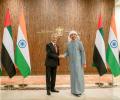
Frankly, was it really necessary in the middle of a fratricidal war for External Affairs Minister S Jaishankar to travel to Abu Dhabi for a one-on-one with the sheikh on April 12?Or, for National Security Advisor Ajit Doval to follow up on April 26? Or, for PM Narendra Modi to follow through today? There are no easy answers, notes Ambassador M K Bhadrakumar.

Dhabi's Masdar Institute of Science and Technology -- an independent, non-profit institution -- will conduct the study alongwith Boeing and Yale University's School of Forestry and Environmental Studies, to examine the possibility for sustainable, large-scale production of biofuel from halophyte plants like salicornia bigelovii and saltwater mangroves.
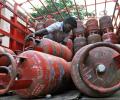
The cost of non-subsidised LPG -- the one that consumers buy after exhausting their quota of 12 bottles of 14.2-kg at below market price -- has been cut by Rs 100.5 to Rs 637.

Jet fuel prices on Thursday were hiked by the steepest ever 16 per cent to catapult rates to an all-time high in step with hardening international oil rates.
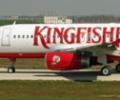
In a major initiative to strengthen the cash-strapped aviation sector, a group of ministers on Tuesday decided to allow airlines to directly import jet fuel to enable them save on high incidence of tax and permit Air India to raise Rs 7,400 crore (Rs 74 billion) by issuing bonds or other means.

Markets will look for clear guidance on how the MPC interprets the uncertainty and what it implies for the future course of monetary policy, points out Rajeswari Sengupta.
 © 2026 Rediff.com - Advertise with us - Disclaimer - Privacy Policy - Sitemap - Feedback - About us - Terms of use - Grievances